Skip to content
Wood Pellets vs Briquettes for UK Stoves
A bag of fuel can look like a simple purchase until it is time to light the stove. Wood pellets vs briquettes is not mainly a question of which one burns hotter. The right choice depends on your appliance, how you use it, the space you have for storage and whether you want automated heating or a more traditional fire.
Both fuels are made from compressed wood and can offer a clean, efficient alternative to damp, poorly stored logs. But they are not interchangeable. Put pellets in a conventional log burner and they will not perform as intended; use briquettes in a pellet stove and you could damage the appliance. Start with the manufacturer’s instructions, then choose fuel that suits the way you heat your home.
Wood pellets vs briquettes: the key difference
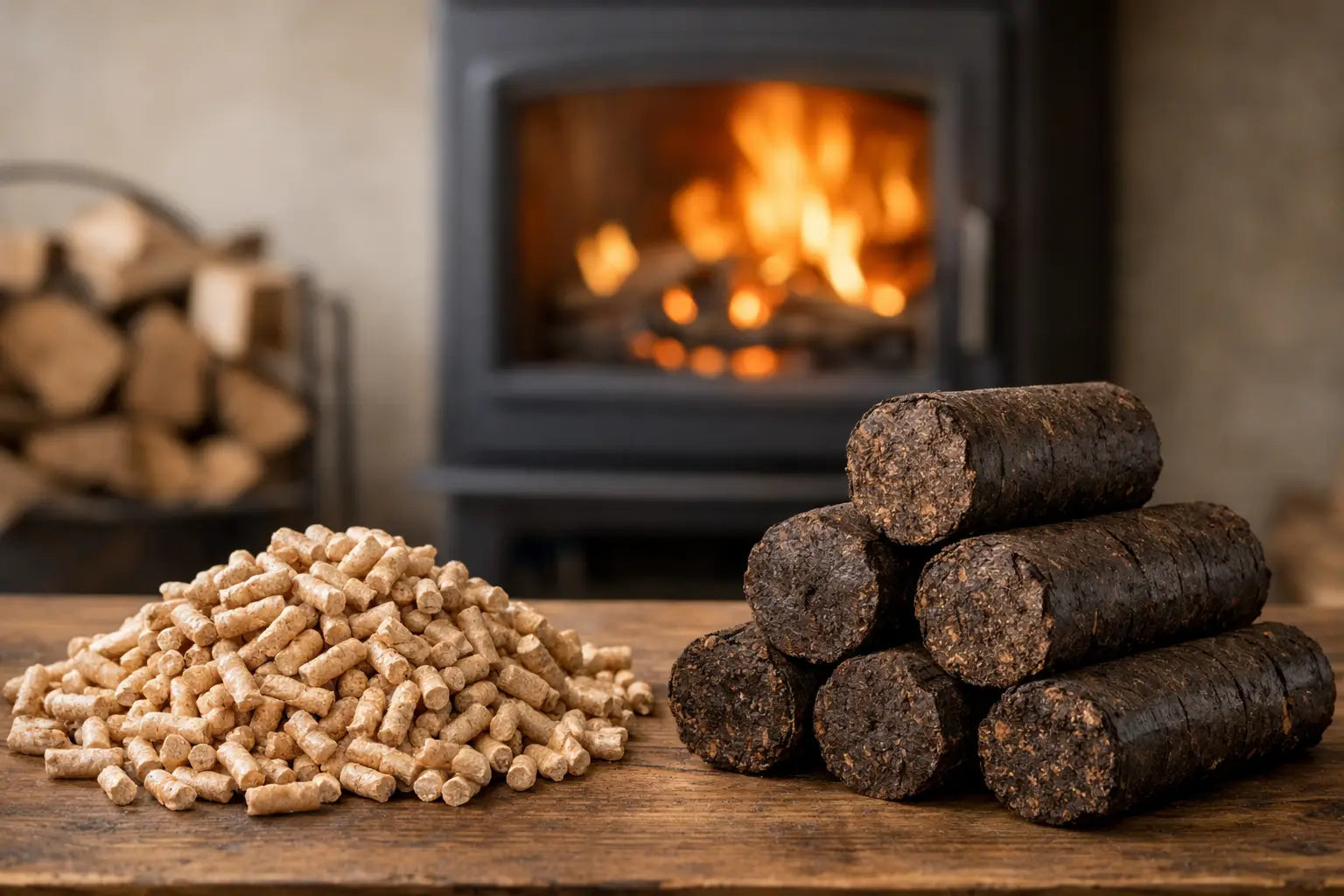
Wood pellets are small, uniform cylinders of compressed wood. They are made specifically for pellet stoves and pellet boilers, where an auger automatically feeds measured amounts of fuel into the burn chamber. This controlled delivery is what gives pellet heating its convenience: with the correct appliance and settings, it can maintain a steady output with far less hands-on refuelling than a log burner.
Briquettes are larger blocks or cylinders of compressed wood. They are designed to be placed by hand into suitable wood-burning stoves, multi-fuel stoves, fireplaces and fire pits, subject to the appliance manufacturer’s guidance. They behave more like logs, but their low moisture content and dense structure can give a longer, more consistent burn than ordinary firewood.
The practical distinction is simple. Pellets are an appliance-specific fuel for automated systems. Briquettes are a hand-loaded solid fuel for people who want the familiarity of a real fire with less moisture and mess than unseasoned wood.
Choose fuel to match your appliance
This is the decision that matters most. A pellet stove requires pellets of the specified grade and size. Many domestic pellet appliances are designed for premium low-ash pellets, often certified to a recognised quality standard such as ENplus A1. The fuel’s consistency helps the feed mechanism, ignition system and combustion controls work correctly. Using the wrong grade can lead to poor burning, excess ash, error messages and avoidable maintenance.
A wood-burning stove, by contrast, is usually built for logs and may also accept wood briquettes. Check the manual before using any briquette, particularly if you have a compact stove. Some briquettes expand as they burn, and a dense block can produce significant heat. Do not overfill the firebox or assume that a larger briquette is always better value. Use a sensible amount for the stove’s rated output and keep air controls in the operating range recommended by the manufacturer.
Multi-fuel stoves need an extra check. Some are suitable for wood briquettes on a flat grate or in a dedicated wood-burning configuration, while others are optimised for approved smokeless fuels. If you live in a Smoke Control Area, ensure both your appliance and chosen fuel meet local requirements. An exempt stove must still be used correctly to minimise smoke.
Heat output and burn control
Both products are manufactured from dry, compressed wood, so they generally provide more predictable performance than wet logs. Damp wood spends a substantial part of its energy boiling off water before the room receives useful heat. Low-moisture fuel burns more readily, produces a clearer flame and helps keep the stove glass and flue cleaner when the appliance is operated properly.
Pellets offer the highest level of control because the stove regulates how much fuel enters the burner. You can usually set a target temperature or output level, while the appliance adjusts its feed rate and fan. That makes pellets especially useful where a stove or boiler is a regular part of the household’s heating routine, rather than an occasional evening fire.
Briquettes provide control in a different way. You decide when to add fuel, how much to load and how to manage the air supply. A good briquette can give a steady, long-lasting bed of embers, which is useful for extending the burn between log refills. However, the heat output can feel more immediate than with logs because the fuel is so dry and dense. For a smaller room, use fewer briquettes and avoid shutting the stove down too aggressively in an attempt to make them last.
No fuel can compensate for an incorrectly sized or poorly maintained stove. If your room regularly becomes too hot, the problem may be appliance output, loading practice or insulation rather than the type of wood fuel you buy.
Cost: compare usable heat, not just the bag price
Pellets and briquettes are sold in different formats, so a straight price comparison can be misleading. Pellets are often supplied in sealed bags, sometimes stacked on pallets for larger users. Briquettes may be sold in packs, bundles or larger packs. The number of bags or blocks tells you little without knowing the net weight and expected burn time.
For a fairer comparison, look at price per kilogram and, where available, the stated calorific value. Then consider how efficiently your appliance uses that fuel. A pellet stove’s controlled combustion may reduce waste during regular use. Briquettes can make sense for a conventional stove if they replace several damp logs or reduce the frequency of refuelling.
Storage, delivery and convenience also form part of the real cost. Bulk fuel can offer strong value when you have a dry, accessible place to keep it. For households that rely on solid fuel through winter, ordering a sensible quantity before cold weather arrives can prevent rushed purchases and inconsistent quality.
Storage and handling at home
Pellets must be kept completely dry. Even small amounts of moisture can cause them to swell and break down into sawdust, which may interfere with a pellet stove’s feed system. Keep unopened bags indoors, in a dry shed or in a weatherproof store raised off the ground. Once opened, reseal the bag or transfer the pellets to a dry lidded container.
Briquettes also need dry storage, although they are generally easier to handle in smaller quantities. Keep packs away from rain and condensation, and bring only what you need indoors. Avoid storing either fuel directly against a stove, boiler or other heat source.
A tidy fuel store makes daily heating easier. Pellets are compact but can be dusty when poured; briquettes are quick to carry and stack but take up more room per unit than loose pellets. Consider the route from your store to the appliance as well as the overall capacity. A pallet delivery is only convenient if there is suitable access and a dry place ready for it.
Ash, cleanliness and maintenance
Quality pellets are commonly chosen for their low ash content, but pellet appliances still need routine emptying, cleaning and servicing. Ash can build up in the burn pot and heat exchanger, while dust in the hopper or feed system should be managed according to the manufacturer’s instructions. Use only a suitable ash vacuum once all ash is cold.
Wood briquettes usually produce relatively little ash compared with wet or low-quality wood, but the exact amount varies by product and raw material. Their clean performance depends on burning them with sufficient air. A stove starved of oxygen can create soot, tar deposits and unnecessary emissions, whatever fuel is inside it.
For either option, keep the flue swept at the recommended intervals and have the appliance serviced as required. A carbon monoxide alarm in the same room is essential, and ventilation must never be blocked.
When pellets are the better choice
Choose pellets if you own a dedicated pellet stove or boiler and want predictable, programmable heating with minimal manual tending. They are particularly suited to households using their appliance daily, properties where controlled background heat is useful, and buyers able to store several sealed bags or a larger pallet order in a dry area.
Pellet heating does rely on electricity for its controls, fan and feed mechanism. During a power cut, most pellet stoves will not run, so it is worth considering a separate backup heating arrangement.
When briquettes are the better choice
Choose briquettes if you use a compatible log burner or fireplace and want a dry, compact fuel that can be lit and loaded by hand. They work well alongside kiln-dried logs: kindling and smaller logs can establish a fire quickly, while a briquette can help maintain a longer, steadier burn later in the evening.
For many homes, briquettes are also a practical answer to limited storage. Their regular shape stacks neatly, and sealed packs avoid the uncertainty of buying loose wood that may have been exposed to rain. Buy from a supplier that clearly states product weight, intended use and delivery format, so you can compare value with confidence.
The best fuel is the one your appliance was built to burn, stored dry and used with care. Once that is in place, the choice becomes less about fashion and more about a warm home, reliable performance and fewer surprises when the temperature drops.