Skip to content
Choosing a Premium Hardwood Supplier in the UK

A fire can look ready for the evening and still disappoint. If logs hiss, blacken the stove glass or give off more smoke than heat, the problem is usually the fuel rather than the appliance. Choosing a premium hardwood supplier means buying logs that are properly dried, clearly described and delivered in a format that suits how often you burn.
For households relying on a log burner, open fire or multi-fuel stove, quality firewood saves more than time at lighting-up. It helps produce a cleaner, steadier fire, reduces avoidable mess and makes it far easier to plan a winter fuel order with confidence. The best choice is not always the cheapest bag at first glance. It is the fuel that gives you dependable heat for the volume and price paid.
What a Premium Hardwood Supplier Should Provide
Premium firewood is not simply a label attached to a log. It should be backed by practical information that allows you to judge what you are buying. Start with moisture content. Wood with a moisture content below 20% is suitable for efficient domestic burning, and Ready to Burn certification provides useful reassurance that the logs meet the required standard.
Wet or poorly seasoned wood uses much of the fire's energy to drive off water. That leaves less heat for the room, creates more smoke and can contribute to soot and tar deposits in the flue. Kiln-dried hardwood costs more to prepare than unseasoned timber, but it arrives ready to use. For many households, that certainty is worth far more than a lower price on wood that may need months of drying space.
A reliable supplier should also be open about the species, format and volume supplied. Firewood is often sold in nets, bags, boxes, crates or bulk loads, but those descriptions alone do not tell you how much fuel you are receiving. Look for stated loose volume, dimensions or cubic-metre pricing where available. This makes it possible to compare orders fairly rather than guessing from photographs or bag sizes.
Certification and sustainable sourcing matter
Ready to Burn certification is especially useful when buying online, where you cannot inspect logs before delivery. It signals that the wood has been tested or assessed to meet the moisture requirement. It does not mean every log will be identical in shape or size, but it does mean the fuel should be dry enough to burn efficiently in a suitable appliance.
Sourcing matters too. Responsibly managed timber supplies support a more sustainable fuel chain, while good processing standards help minimise unnecessary waste. Ask whether the supplier explains where its wood comes from, how it is dried and whether the stated product is appropriate for domestic stoves and fireplaces. Straight answers are a good sign that quality controls are being taken seriously.
Consistency is more useful than a bargain that varies
One load of excellent logs cannot make up for the next delivery being damp, undersized or poorly packed. Consistency is what turns an online firewood order into a dependable part of household heating. Established suppliers should provide clear product specifications and keep their log formats reasonably consistent, even though natural wood will always vary.
Customer reviews can be helpful here, particularly when they mention dryness, delivery condition and how well the wood burns. Read beyond the star rating. A useful review explains whether the logs were practical for a stove, whether the stated quantity felt accurate and whether delivery was handled properly.
Choose Hardwood Logs for the Way You Burn
Hardwoods are popular because they are generally denser than softwoods and can provide longer-lasting heat. However, there is no single best species for every home. The right choice depends on your stove, the size of your firebox, how quickly you need heat and whether you are lighting a short evening fire or maintaining warmth for several hours.
Ash is widely valued for its dependable burn and balanced heat output. It is a practical all-round choice for regular stove users. Birch usually lights readily and produces an attractive, lively flame, making it useful when you want a fire established quickly. Because it can burn faster than denser species, it is often best paired with a longer-burning hardwood rather than used alone for an all-evening fire.
Hornbeam is particularly dense and suits households looking for a longer burn and strong heat output. Oak also burns slowly and steadily once established, although it benefits from a good, hot firebed. Alder can be a convenient option for quicker fires and easier lighting. A good supplier will make these differences clear rather than implying that every hardwood log performs in exactly the same way.
Log size should fit the appliance
Even the driest hardwood is inconvenient if it is too long or thick for your stove. Check your appliance manual or measure the firebox before ordering. Most domestic stoves need logs that can be placed inside with room for airflow, not forced against the glass or baffle.
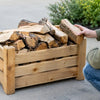
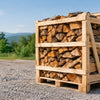
If you have a smaller stove, fire-box packs or neatly cut bagged logs may be the simplest choice. For frequent burners with suitable storage, crates and palletised supplies can offer better value per cubic metre. Larger orders reduce the need for repeated purchases, but only make sense if you can keep the wood dry and accessible after delivery.
Compare Firewood by Volume, Not Just the Price
The lowest headline price can be misleading. A small net may be convenient for a weekend, while a crate may provide substantially better value for regular use. Compare like with like by checking loose volume, number of bags, log length and the price per cubic metre where it is shown.
Also consider what is included. Some suppliers offer free kindling with selected orders, which can reduce the need to buy separate fire-starting materials. Delivery charges matter just as much. A cheap product can become poor value once carriage is added, especially for heavy fuel orders. Clear delivery information, including postcode coverage and expected fulfilment times, should be available before you reach the checkout.
Candowe provides kiln-dried Ready to Burn hardwoods in formats ranging from convenient bags and fire-box packs to larger crates, helping customers match an order to both their storage space and expected usage. For mainland UK buyers, free delivery across most postcodes can make the overall cost easier to calculate from the start.
Do not overlook storage after delivery
Kiln-dried logs can absorb moisture again if they are left exposed to rain or placed directly on damp ground. Store them in a dry, ventilated log store or sheltered area with airflow around the stack. A solid roof is more important than sealed sides, as wood needs ventilation to remain in good condition.
Bring a small quantity indoors before use, especially during colder or wetter weather. This keeps the next load close at hand without turning the house into a long-term wood store. Avoid packing logs tightly into an unventilated shed or covering the entire stack with a waterproof sheet that traps condensation.
Delivery and Service Are Part of Fuel Quality
A premium product still needs a dependable delivery process. Before ordering, check the supplier's lead time, whether the consignment will arrive by parcel carrier or pallet delivery, and where it can safely be left. Crates and bulk fuel may require clear access for a pallet lorry and a suitable hard surface near the property.
For rural homes, this detail is particularly important. A narrow lane, steep drive or loose gravel can affect where a large order is placed. Giving accurate delivery instructions early can prevent unnecessary delays and ensure the fuel is stored where you need it. If you are ordering for a small business, holiday let or larger property, regular bulk orders may also be easier to manage than running short during a cold spell.
Good service includes payment flexibility as well as delivery clarity. Spreading the cost can be useful for larger seasonal orders, provided you still choose a quantity you can store properly. The aim is not to buy the biggest possible load. It is to keep a practical reserve of dry, certified fuel that suits your appliance and your household routine.
When the temperature drops, good firewood should be the straightforward part of heating your home. Choose dry logs, compare genuine volumes, plan storage before delivery and buy from a supplier that explains exactly what will arrive. That leaves you with a fire that lights cleanly, burns as expected and earns its place in the house.