Skip to content
Best Firewood for Wood Burners
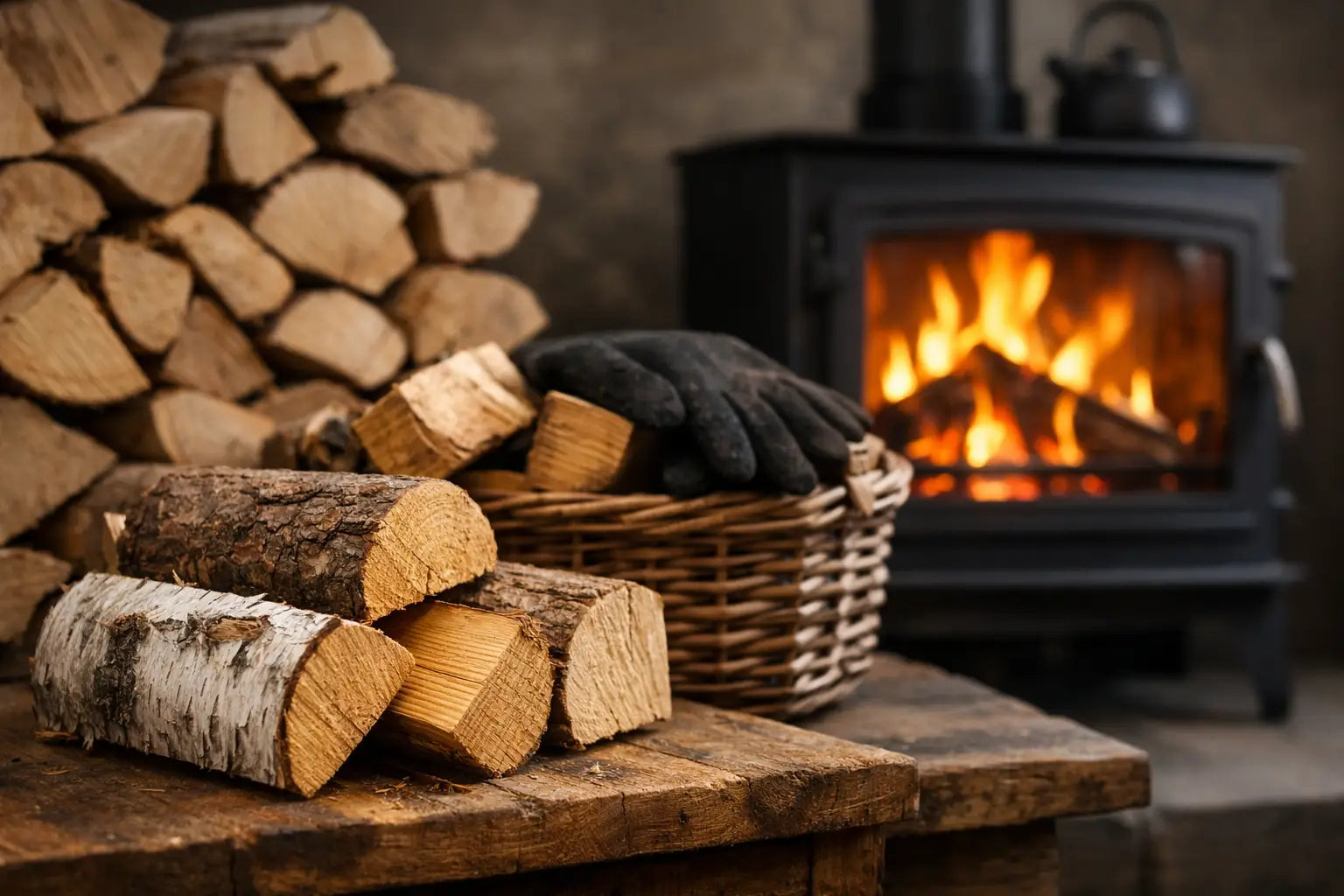
Cold evenings quickly expose poor fuel. If your stove struggles to light, the glass blacks up or the room never seems to get properly warm, the issue is often the firewood for wood burners rather than the appliance itself. Good logs should arrive dry, burn cleanly and give you predictable heat without constant fuss.
That matters because a wood burner performs best when the fuel matches the job. Wet or inconsistent logs waste heat driving off moisture, create more smoke and leave you cleaning out soot far more often than you should. For most households, better firewood means easier lighting, steadier heat and better value over the course of the heating season.
What makes good firewood for wood burners?
The first thing to look at is moisture content. For a modern stove, logs should be under 20% moisture and ideally supplied ready to burn. That threshold is not a technical detail to skim past - it has a direct effect on how well your stove works day to day.
When logs are properly dried, more of the fuel is used to produce heat rather than evaporate water. You get a livelier flame, less smoke and fewer deposits building up in the flue. In practical terms, that means less time coaxing a fire back to life and more confidence that the fuel you bought is actually doing its job.
Species matters too, but not in a simplistic hardwood-good, softwood-bad way. Dense hardwoods such as oak, hornbeam, ash, birch and alder are popular for wood burners because they provide reliable heat and a solid burn profile. Some burn longer, some light faster, and some are particularly useful for mixing together depending on how you use your stove.
Log size is another part of the picture. Even excellent logs can be awkward if they are too large for your stove chamber or too uneven to stack and light easily. Consistent sizing helps airflow, makes loading simpler and gives a more controlled burn.
Why kiln-dried logs usually make more sense
If you have the space and patience, seasoning your own wood can work. The trade-off is time, uncertainty and effort. Air-dried wood may still hold too much moisture depending on how it has been stored, how long it has had to dry and what the weather has done in the meantime.
Kiln-dried logs remove much of that guesswork. They are dried in controlled conditions to bring moisture down to a level suitable for stove use, so they arrive ready for the fire rather than needing months of storage before they become practical. For households that want dependable heat without the hassle, that consistency is a major advantage.
It also helps with compliance and confidence. Ready to Burn certified fuel gives you a clear standard to buy against, especially if you have had disappointing experiences with loosely described "seasoned" logs from local sellers. You know what you are paying for and you can expect the fuel to perform as intended.
Choosing between birch, ash, oak, alder and hornbeam
Different species suit different households and burn habits. Birch is a strong all-round option because it lights easily, burns brightly and gives quick, satisfying heat. It is often a good choice if you want convenient day-to-day logs that are straightforward to use.
Ash is valued for its steady burn and dependable heat output. It is often chosen by stove owners who want a practical balance between ease of use and lasting performance. For general home heating, it is hard to go wrong with properly dried ash.
Oak is denser and tends to burn more slowly, which can be useful when you want a longer-lasting fire. The trade-off is that it usually performs best once the stove is already established, rather than as the easiest option for getting a fire started from cold.
Alder can be a very sensible choice if you prefer a clean, efficient burn for regular use. Hornbeam is another dense hardwood with strong heat output and good burn duration, making it attractive for customers who prioritise fuel performance over novelty or appearance.
There is no single best species for every home. If you use your stove mainly in the evening for a few hours, birch or ash may suit you perfectly. If your burner is an important part of your heating routine in colder weather, denser logs such as oak or hornbeam can offer better staying power.
The real cost of cheap logs
Low headline prices can be misleading. Firewood that looks cheap at the point of purchase may contain excess moisture, poor sizing or inconsistent species, all of which affect how efficiently it burns. You often end up using more logs to achieve the same room temperature, and the stove may need more maintenance because of soot and residue.
That is why transparent volumetric pricing matters. Comparing cost per cubic metre or loose volume gives a fairer picture than comparing packs that look similar but contain very different amounts of usable fuel. It also helps when deciding whether a crate, bagged logs or larger palletised supply offers the best value for your household.
Delivery and convenience have a cost value as well. Reliable nationwide supply, especially in colder months when local stock can become patchy, saves time and removes uncertainty. For many buyers, that reliability is worth just as much as a small saving on paper.
Storage matters after delivery
Even premium firewood can underperform if it is stored badly once it reaches your property. Logs should be kept somewhere dry, ventilated and protected from persistent rain. A garage, log store or covered outdoor area usually works well as long as air can move around the stack.
What you want to avoid is trapping moisture in. If logs are packed tightly in a damp shed or left exposed under a fully sealed sheet, condensation can become part of the problem. Firewood stays at its best when it is sheltered but still able to breathe.
It also helps to bring a small quantity indoors before use, particularly in very cold or damp weather. That gives the surface moisture a chance to settle and makes lighting easier. You do not need to overcomplicate it - just keep your main stock protected and your near-term supply accessible.
Matching log format to how you buy
Not every customer needs the same format. Small households or occasional stove users may prefer manageable net bags or compact fire-box packs that are easy to carry and store. Buyers with more regular heating demand often get better value from larger crates or pallet quantities, especially if they want to reduce reorder frequency over winter.
This is where structured product information becomes genuinely useful. Knowing the bag size, weight, loose volume and price basis lets you judge value clearly rather than buying on appearance alone. If you burn wood regularly, those details help you estimate how long a supply is likely to last.
For trade customers or heavier domestic users, larger-volume ordering often makes the most financial sense. It reduces delivery disruption, supports stock planning and gives more confidence going into colder periods when demand tends to rise.
Signs your current logs are not good enough
Some problems are easy to miss because they build gradually. If your stove glass blackens unusually quickly, if lighting a fire takes more kindling than it should, or if the fire hisses and smoulders before it settles, your logs may be too wet. A weak flame and disappointing heat output tell the same story.
There are other clues as well. Excess ash, heavy smoke and a strong need to keep the air controls wide open can all point to fuel quality issues. While appliance setup and airflow matter, poor logs are often the simplest explanation.
Buying better firewood is often the fastest fix. In many cases, households assume the stove is inefficient when the real problem is fuel that was never properly dry or consistently prepared in the first place.
A better way to buy firewood for wood burners
The easiest route is to buy from a supplier that makes the key facts obvious. You should be able to see moisture standards, product format, species and delivery terms without having to chase basic information. That level of clarity usually reflects the quality of the wider service as well.
Candowe focuses on exactly that approach - premium kiln-dried logs, clear product specifications and dependable delivery that helps customers stock up with less hassle. For homeowners and business buyers alike, certainty is often what makes the difference between a stressful fuel purchase and a straightforward one.
When you choose firewood for your wood burner, think beyond the price on the first screen. Dry fuel, consistent sizing, sensible storage and the right species for your burn habits will always give you a better result when the temperature drops.