Skip to content
How a Firewood Bulk Buy Saves UK Homes Money
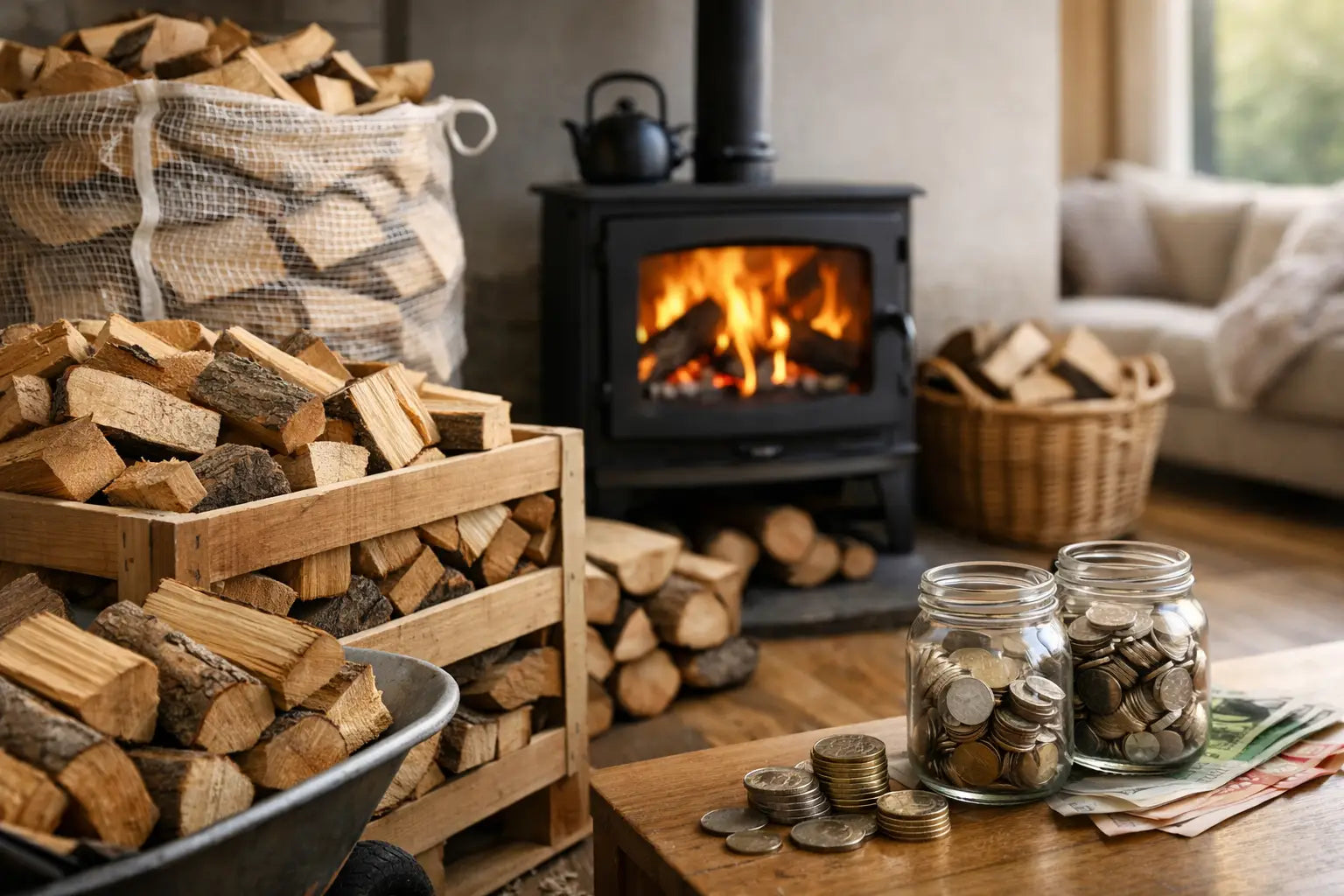
A cold evening is not the time to find that the log store is low, the remaining wood is damp or the local supplier has run out. A planned firewood bulk buy gives households more control over cost, quality and convenience, particularly for homes that rely on a stove or fireplace through autumn and winter.
Buying a larger quantity is not simply about ordering the biggest load available. The best value comes from matching the volume, wood type and packaging to how often you burn fuel, the storage space you have and the performance you expect from each fire. Dry, certified logs that arrive ready to burn can reduce the uncertainty that often comes with loosely described local loads or unseasoned timber.
Why a firewood bulk buy makes practical sense
Bulk buying can lower the cost per cubic metre compared with purchasing a few bags at a time. It also reduces the risk of making repeated, last-minute orders when demand is highest and delivery slots are busiest. For regular stove users, a palletised crate or larger supply can be a more dependable way to stay stocked.
There is also a quality advantage when you choose properly specified fuel. Logs with a moisture content below 20% burn more efficiently than wet wood, producing more useful heat with less smoke, tar and unnecessary mess in the stove. Ready to Burn certified firewood provides a clear standard for domestic users: the wood has been tested and is suitable to use without further seasoning.
The saving will depend on how much wood you actually use. A household lighting the stove on weekends may be better served by smaller fire-box packs, bags or a modest crate. A home using a log burner most days in winter, however, can make better use of a larger delivery, provided there is somewhere dry and accessible to store it.
Start with your real fuel use
Before placing a bulk order, consider last winter's consumption. If you bought nets or bags frequently, count roughly how many you used over the season. If you have previously ordered crates, think about how long each crate lasted and whether your stove was used for occasional comfort heating or as a meaningful part of the household's heat.
Usage changes with the weather, insulation, room size and stove efficiency. A well-insulated home with a modern stove may use far fewer logs than an older rural property with a large open fireplace. Open fires are enjoyable but generally use fuel less efficiently, so they can require a greater volume of logs for the same perceived warmth.
It is sensible to leave a margin rather than ordering to the exact last log. A cold spell can change consumption quickly. At the same time, do not over-order simply because the unit price is lower. Firewood needs dry, ventilated storage, and a supply that is difficult to protect from rain or ground moisture is false economy.
Compare volume, not just the advertised format
Firewood is sold in several practical formats, including net bags, plastic bags, fire-box packs and rigid crates. These are useful for different homes, but comparison is only meaningful when you understand the amount of wood supplied.
A crate normally provides a stated loose volume of logs, which is far more useful than judging a load by appearance. Log sizes, how tightly they are stacked and the shape of the container can all make two apparently similar products look different. Check the stated volume and price per cubic metre where available, then compare like for like.
Bagged logs are convenient for properties with limited access or storage, and they are easy to carry to the stove. They may not offer the same price per cubic metre as a larger crate, but convenience can be worth paying for if a pallet delivery would block access or leave you handling more wood than you can store.
For a firewood bulk buy, a hard crate often offers a useful balance. It keeps the delivery contained, makes the amount ordered transparent and allows buyers to move logs into a log store gradually. Make sure there is safe access for the delivery vehicle and a suitable place for the crate to be set down before ordering.
Choose a species that suits your stove and routine
All quality kiln-dried logs should light readily and burn cleanly when used correctly, but different species have different strengths. The right choice comes down to the heat output you want, how long you prefer a fire to last and how you use your appliance.
Birch is popular because it lights easily and provides an attractive, lively flame. It is a practical choice for regular fires and for households that value quick heat. Alder is also easy to light and can be well suited to smaller stoves or shorter burns.
Harder woods such as oak, ash and hornbeam are often chosen for their dense structure and longer-lasting burn. They can be particularly useful for sustained evening heating, although they benefit from a well-established fire. Many households use a combination: easier-lighting logs to get the fire going, then denser hardwood logs to maintain steady warmth.
Species is only one part of the decision. Moisture content matters more than a fashionable wood name. A kiln-dried, Ready to Burn certified log with clear product information is usually a safer choice than a vaguely described load of "seasoned" logs with no moisture assurance.
Do not forget kindling and firelighters
Bulk logs work best when the rest of the fuel set-up is ready too. Dry kindling helps establish a clean, hot fire quickly, reducing the temptation to use excess paper or unsuitable household materials. Some larger orders include kindling as an added extra, which can make stocking up simpler.
Use only suitable firelighters and follow your stove manufacturer's guidance. Never burn treated timber, painted wood, rubbish or wood collected from unknown sources. These materials can release harmful pollutants and may damage your stove and flue.
Storage decides whether your logs stay ready to burn
Kiln-dried firewood arrives dry, but it cannot remain in good condition if it is left exposed to persistent rain. Store logs off the ground, with a roof or cover above them and airflow around the sides. A purpose-built log store, covered side passage or dry outbuilding can work well.
Avoid wrapping a full stack tightly in plastic. This can trap moisture and reduce ventilation. If a cover is needed, protect the top while leaving the sides open enough for air to circulate. Bring a small quantity indoors only when you are ready to use it, especially if indoor space is limited.
Accessibility matters as much as protection. Position the main store somewhere that is easy to reach in poor weather, but not so close to the stove that it creates a fire risk. Keeping a small log basket indoors and replenishing it regularly is usually the simplest arrangement.
Check delivery details before you order
A larger order should feel convenient from checkout to the first fire. Review the supplier's stated delivery area, expected lead time and any access requirements for crate or pallet deliveries. Nationwide delivery is useful, but the final drop point still depends on safe access at your property.
Consider narrow lanes, steep drives, loose gravel, gates, low branches and steps. A pallet cannot usually be wheeled across rough ground or up a slope, so plan a sensible hard-standing location near the entrance if possible. If access is restricted, bagged formats or smaller deliveries may be more practical than a large crate.
It is also worth checking whether delivery is included in the price. Free delivery across most mainland UK postcodes can materially improve the value of a bulk order, particularly in rural locations where collecting fuel can involve several journeys and considerable time.
Look beyond the initial price
The cheapest-looking logs are not always the best value. Wet wood gives less heat for its weight because energy is spent driving off water. It can also produce more smoke and contribute to deposits in the stove and chimney. A lower-priced load that needs additional drying, burns quickly or contains inconsistent pieces can cost more over the season.
Assess value through clear measures: certified moisture content, stated volume, species, log size, delivery cost and whether kindling is included. Reliable fulfilment matters too. A household that runs its stove regularly needs fuel to arrive when promised, not an uncertain arrangement that leaves them searching for bags during a cold week.
Candowe supplies kiln-dried, Ready to Burn certified logs in formats suited to both smaller top-up orders and larger household stocks, with transparent volume information to make comparisons easier.
A well-planned order is one less winter job to think about. Choose dry fuel, order a realistic volume, prepare the storage space and leave enough stock for the colder weeks ahead. Then the logs are ready when you need them, rather than becoming another problem to solve after the temperature drops.